Monday, September 28, 2015

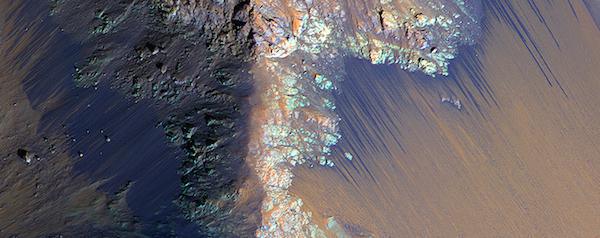
Flowing Water on Mars

NASA confirms that dark streaks called recurring slope lineae are caused by liquid briny water.


Update (June 8, 2018):  Organic molecules have been discovered in an ancient lakebed.

Update (July 25, 2018):  An underground lake has been discovered.

Update (March 31, 2019):  A paper published in Science Advances shows that Mars had running rivers for billions of years.

Update (May 20, 2019):  Pluto might have a liquid ocean under its surface.

Update (September 14, 2020):  Mars always seemed the most likely place to have life or had life besides Earth. But now the detection of phosphine in the upper atmosphere of Venus suggests life may have adapted to harsh conditions there. So far, a nonbiological explanation hasn't been found. Seth Shostak:
If you find life on the next planet over, you might say, "well, maybe we're not all that special".

Update (September 28, 2020):  A study published in Nature Astronomy presents evidence of additional underground lakes at the Martian south pole. 

Update (November 29, 2020):  A review of data finds only about one-fourth as much phosphine as previously estimated for Venus.

Update (February 3, 2021):  A new study suggests that an unexpected amount of sulfur dioxide in the atmosphere of Venus was misinterpreted as phosphine. 

Update (July 13, 2023):  Phosphine has been detected again at Venus, but apparently in a lower part of the atmosphere.

Also, a paper published in Nature describes organic compounds on Mars, but doesn't conclude that the compounds are evidence for past life.

Friday, September 4, 2015

Have or Have Not

In their book $2.00 a Day: Living on Almost Nothing in America, authors Kathryn Edin and Luke Shaefer report that extreme poverty has “more than doubled since 1996, placing 1.5 million households and 3 million children in this desperate economic situation.”  1996 is when Aid for Families with Dependent Children was eliminated.

Meanwhile, Hanna Brooks Olsen contrasts the fact that the rich are getting richer with polling results showing that most Americans identify themselves as "haves".


Class is a hidden topic in American political discourse. Olsen:
As long as we Americans continue to see ourselves as “haves” in the economic system, we’ll continue to think that this degree of economic inequality is normal and unavoidable. But the extreme bounties of the ultra-wealthy should be a clear indicator that, even though there’s enough wealth to go around, most of us are being screwed out of seeing any of it.

Wednesday, September 2, 2015

Partisan Poll Results

Ariel Edwards-Levy reports on a HuffPost/YouGov poll showing how people respond to question cues.
[M]ost Americans, regardless of their political views, don't have a solid opinion about every single issue of the day, particularly when it concerns a complicated or obscure topic. People tend, reasonably, to rely on partisan cues -- if a politician they support is in favor of a bill, they're likely to think it's a good idea, or vice versa.

Trees

The World Resources Institute reports that 45 million acres of trees were lost in 2014 (an area twice the size of Portugal). But, also, a forest survey published in Nature finds there are about 3 trillion trees on Earth (far more than previously estimated). However, that's a 46 percent decrease since humans started cutting them down.

Update (December 22):  A study published in Nature Climate Change projects that unchecked warming could wipe out evergreen trees in southwestern U.S. by the end of this century.

Update (February 8, 2016):  A study published in Landscape Ecology warns that development projects are shifting forests to a more fragmented condition.
Between 2000 and 2012, the world lost more forest area than it gained, according to U.S. Forest Service researchers and partners who estimated a global net loss of 1.71 million square kilometers of forest -- an area about two and a half times the size of Texas. Furthermore, when researchers analyzed patterns of remaining forest, they found a global loss of interior forest -- core areas that, when intact, maintain critical habitat and ecological functions.
Update (February 17, 2016):  Bruce Melton writes about beetles, dying forests, and abrupt climate change.

Update (April 8, 2017):  Botanic Gardens Conservation International has created a database of over 60,000 species of trees. At least 15 percent of the species are considered at risk for extinction.

Update (May 29, 2017):  Tree plantations alone could not remove enough carbon dioxide from the atmosphere to limit warming to 2 degrees Celsius.

Update (January 14, 2018):  Daniel Meek discusses an infographic about deforestation.
To understand the ecological importance of trees to our planet, Alton Greenhouses, a greenhouse manufacturer based in the United Kingdom, analyzed various scientific studies and comments from environmentalists to imagine a world without trees. The results are alarming. In addition to flash floods and food shortages, humanity would also have to deal with widespread animal extinctions, accelerating climate change and the loss of materials.
Update (June 19, 2018):  John Vidal discusses how older, larger trees are most vulnerable to climate change.

Thursday, August 27, 2015

July Was Warmest Month on Record

While some barely noticed, it is significant that last month was the warmest ever in our weather records. The previous record was 17 years ago and the new one will be ... next year?

Update (August 5, 2019):  It's been three years since the previous warmest month ever, but it's a record that's bound to be broken over and over in the years to come. This July was only 0.04 degrees Celsius above July 2016 (1.2 degrees above pre-industrial mean). But in a non-El Nino year.

Update (August 15, 2019):  NOAA confirms July was 0.03 degrees Celsius above the previous record.

Update (August 13, 2021):  So a new record for warmest month in the historical record--last month was 0.93 degrees Celsius above the 20th century average.
The picture is particularly bleak for the Northern Hemisphere, where the land temperature was 2.77 degrees Fahrenheit (or 1.54 degrees Celsius) above the 20th-century average.

Saturday, August 22, 2015

Campaign Zero

People protest for a reason. Sophia Tesfaye examines the agenda.

Update (January 20, 2016):  Stephen Colbert discusses white privilege with Campaign Zero activist DeRay McKesson.
Colbert articulated a vulnerability that I think a lot of white Americans are afraid to cop to without resorting to anger or defensiveness: “I don’t know if I do understand [white privilege]. I can acknowledge it, but I don’t know if I understand what I can do to dismantle white privilege.” McKesson observed that Colbert has a platform and a fortune that he could mobilize; Colbert responded, with a response so straight-faced it went beyond deadpan: “You can’t have my money… And you can’t have my show.”
McKesson changed tactics. “Why do you think white people are uncomfortable talking about race?”
Colbert responded: “I can’t speak for other white people. I feel guilty for anyone who does not have the things I have. That includes black people or anyone, because I am so blessed — I think there’s always a fear that it will be taken from me.”
McKesson responded, with fully engaged sincerity: “What can you do to manage that guilt?”
And in what might be the most glorious cop-out in the history of television, Colbert joked, “I drink a fair amount,” before shifting in his seat uncomfortably, rebuttoning his blazer, and muttering, “I don’t know, I’m shooting from the hip here.” Colbert then looked at the camera for help, and perhaps sensing a chance to wrap things up, he deflected. “I had you on the show, does that help?”
It’s all there: discomfort, guilt, entitlement, and by the end, confusion. Colbert is the stubborn status quo, both trying to understand and disinterested in understanding past a certain point.

Thursday, August 13, 2015

Overshoot Day

According to the Global Footprint Network, today is the earliest within the year that humanity has exceeded a sustainable level of natural resource consumption.

Update (August 22):  One aspect of our over-exploitation of the environment according to a study published in Science is that "humans function as an unsustainable 'super predator'".